Registry
The Registry is ProtoLink's first-class discovery service for A2A-based agent meshes. It uses AgentCard, ProtoLink's runtime form of A2A's identity and capability primitive, as a shared address book where running agents publish who they are and other agents find peers by name, role, tags, capabilities, endpoint, or other card metadata.
Its role is coordination, not orchestration. The registry does not decide which agent should handle a task, route messages between agents, or own workflow state. It answers a narrower question: which agents are currently available, where can they be reached and what do they say they can do?
That separation keeps agent-to-agent communication explicit. Agents still call each other through their own transports and clients, but they no longer need every peer URL hard-coded at startup. A2A 1.0 standardizes per-agent card discovery; ProtoLink adds central indexed lookup, roles and tags, liveness heartbeats, optional TTL pruning, persistence hooks and a browser status view around that model. Those registry endpoints are ProtoLink-native runtime services, not additional A2A 1.0 operations.
Use a registry when agents should discover each other dynamically instead of hard-coding every peer URL.
Quick Start
from protolink.discovery import Registry
from protolink import Agent

registry = Registry(url="http://localhost:9000", transport="http")
agent = Agent(
    name="helper",
    llm="mock",
    url="http://localhost:8001",
    transport="http",
    registry=registry,
)

registry.start(background=True)
try:
    agent.start()
finally:
    registry.stop()
Install protolink[http] and run this as a script. Start the registry first; the agent registers automatically and serves until shutdown. Other agents can use the same registry object or its URL.
While the registry is running, open it with protolink dashboard --registry-url http://localhost:9000 --open.
How It Works
The Registry is both a local runtime object and a transport-backed service. Locally, it stores registered agents by their stable AgentCard.url, keeps liveness metadata in RegistryEntry and maintains secondary indexes for common discovery filters. Over the transport, RegistryClient sends the same registration, heartbeat, unregistration and discovery requests that agents use when they connect to a registry URL.
This means there are two useful ways to think about the API:
- Use
register(),heartbeat(),unregister()anddiscover()when code should talk to a running registry through its configured transport. - Use
count(),list_urls(),get_entry()andclear()when code owns the in-processRegistryobject and needs diagnostics, tests, or local administration.
Incoming transport requests are handled by handle_register(), handle_heartbeat(), handle_unregister() and handle_discover(). Those handler methods update the local store, rebuild indexes as needed, prune expired entries when TTL is enabled and persist entries when storage is configured. Most application code should use the higher-level client methods or Agent registry integration instead of calling handlers directly.
Browser Status
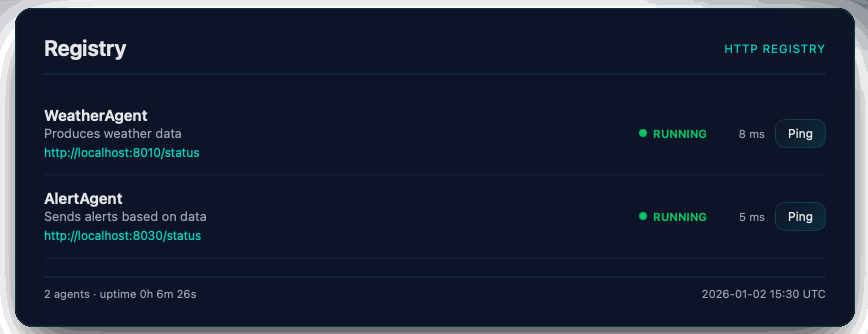
When the registry runs on an HTTP-compatible transport, it exposes a small browser status page at:
GET <registry-url>/status
The page is served by RegistryServer from the same transport-neutral endpoint table as the JSON registry API. In the default HTTP path, HTTPTransport mounts that endpoint on the Starlette or FastAPI backend and returns HTML generated by protolink.utils.renderers.status.to_registry_status_html(). This keeps the page diagnostic-only: registration and discovery still go through the JSON endpoints such as POST /agents/, GET /agents/, DELETE /agents/ and POST /agents/heartbeat.
Agents can receive the live Registry object directly:
from protolink.agents import Agent

agent = Agent(
    card=card,
    transport="http",
    registry=registry,
)
Or they can connect to a registry by transport type and URL:
from protolink.agents import Agent

agent = Agent(
    card=card,
    transport="http",
    registry="http",
    registry_url="http://localhost:9000",
    registry_heartbeat_interval=15,
)
Calling discover() with no filters returns all registered agents.
Discovery
cards = await registry.discover({"name": "weather_agent"})
cards = await registry.discover({"role": "worker"})
cards = await registry.discover({"tags": ["weather", "forecast"]})
Discovery returns AgentCard objects. The same filter shape is available through Agent.discover_agents() and RegistryClient.discover().
Transport Integration
The Registry is transport-agnostic. It relies on a Transport implementation to expose its API.
Internally, Registry composes the transport in two directions:
RegistryClient(transport)is the outbound side. Public methods such asregister(),heartbeat(),unregister()anddiscover()delegate to this client, which turns each operation into aClientRequestSpecand callstransport.send(...).RegistryServer(self, transport)is the inbound side.start()calls the server, the server builds anEndpointSpectable and the transport mounts those endpoint specs as real routes.
When you construct a registry with Registry(transport="http", url="http://localhost:9000"), the string transport is resolved through get_transport(...). The resulting transport instance is passed to both the client and the server, so one configured URL defines both where the registry listens and where registry client requests are sent.
The registry endpoint table is:
| Operation | Client request | Server handler |
|---|---|---|
| Register | POST /agents/ with an AgentCard body | handle_register(card) |
| Unregister | DELETE /agents/ with {"agent_url": ...} | handle_unregister(agent_url) |
| Heartbeat | POST /agents/heartbeat with {"agent_url": ...} | handle_heartbeat(agent_url) |
| Discover | GET /agents/ with query filters | handle_discover(filter_by) |
| Status page | - | GET /status calls handle_status_html() |
For HTTP, HTTPTransport.send() serializes request bodies or query parameters and dispatches them with httpx2.AsyncClient. On the server side, HTTPTransport.setup_routes() delegates to the selected ASGI backend, currently Starlette or FastAPI, which turns each EndpointSpec into a concrete route. HTTPTransport.start() then starts the ASGI server at the transport URL.
Agents use the same path. If an Agent receives a live Registry object, it extracts registry.client. If it receives a transport string plus registry_url, it creates a separate transport and wraps it in RegistryClient. During agent startup, the agent registers its card through that client; if registry_heartbeat_interval is configured, it keeps sending heartbeats through the same client; and Agent.discover_agents() calls RegistryClient.discover().
Currently supported by the default runtime path:
HTTPTransportviatransport="http"
The transport is responsible for:
- Binding to a host and port
- Exposing registry endpoints
- Handling request/response lifecycle
The discovery service for registering agent cards, finding peers by metadata, maintaining secondary indexes and exposing registry operations through a transport.
protolink.discovery.Registryregister()discover()start()entry_ttl_secondsLifecycle Methods
These methods control the registry server component lifecycle.
Registry.start
start(
  *,
  background: bool = False,
) -> NoneStart the RegistryServer and keep its transport lifecycle alive. This public entry point is synchronous even though server startup and shutdown are asynchronous.
Parameters
backgroundbooldefault: False- When false, run the lifecycle with
asyncio.run()and block the caller. When true, start a non-daemon thread with its own event loop, wait for readiness and return.
Returns
NoneNone- Background mode returns after startup readiness or the ten-second readiness wait. Blocking mode returns after shutdown.
Raises
startup error- Transport binding, route setup and server failures propagate. Background failures are captured in the lifecycle thread and re-raised to the caller.
asyncio.run(); from an active loop that raises RuntimeError. Use background=True in async applications and notebooks.Registry.stop
stop() -> NoneCancel the private background lifecycle task and synchronously wait up to ten seconds for its thread to exit. Lifecycle cancellation calls the server's async stop path, which closes the shared transport.
Returns
NoneNone- Returns after the background thread exits or the join timeout elapses.
Execution Models
background=Truestarts the registry in a dedicated background thread with its own isolatedasyncioevent loop and returns immediately. Use this for examples, notebooks, tests and multi-agent scripts.background=Falseblocks the main thread until the registry is stopped. Use this for a standalone registry process.
Common Usage Patterns
Standalone registry service
from protolink.discovery import Registry

registry = Registry(url="http://localhost:9000", transport="http")
registry.start()
Multi-agent orchestration
registry.start(background=True)
agent.start(background=True)

# ...run your orchestration...

agent.stop()
registry.stop()
Always use registry.stop() to cleanly shut down the server and release ports. In blocking scripts, registry.start(background=False) handles KeyboardInterrupt automatically.
Discovery Performance
The Registry is optimized for high-throughput environments where many agents may be registered simultaneously.
Secondary Indexing
To avoid linear scans during common discovery queries, the Registry maintains secondary indexes for:
- Agent name
- Agent role
- Tags
When multiple indexed filters are applied, the Registry performs set intersections and then refines matches for any non-indexed fields.
Robust Fallback
If a query uses non-indexed fields, or if the indexed path returns no candidates while agents are still present, the Registry falls back to a full scan to preserve correctness.
Liveness And Persistence
By default, the registry is an in-memory discovery service. For longer-running systems, two optional knobs make it more robust:
entry_ttl_secondsprunes agents whoselast_seentimestamp is older than the configured TTL.storagepersists registered entries through the genericStorageinterface, so a registry can rebuild its in-memory indexes after restart.
Agents can keep their entry fresh by setting registry_heartbeat_interval on the Agent. After successful registration, the agent periodically calls RegistryClient.heartbeat(agent_url). Heartbeats update liveness metadata only; they do not mutate the agent card or discovery indexes.
from protolink import Agent, AgentCard
from protolink.discovery import Registry
from protolink.storage import SQLiteStorage

registry = Registry(
    url="http://localhost:9000",
    transport="http",
    entry_ttl_seconds=45,
    storage=SQLiteStorage("registry.db", namespace="registry"),
)

agent = Agent(
    AgentCard(name="worker", description="Worker", url="http://localhost:9010"),
    transport="http",
    registry="http",
    registry_url="http://localhost:9000",
    registry_heartbeat_interval=15,
)
The user-facing Registry surface in protolink.discovery.registry.Registry includes:
Registry.register
async register(
  card: AgentCard,
) -> dict[str, str]Send an AgentCard to this Registry's transport-backed client. This does not update the local store directly; the served request returns through handle_register(), even when client and server belong to the same Registry object.
Parameters
cardAgentCardrequired- Complete identity and capability card keyed by its stable URL on the server.
Returns
statusdict[str, str]- Server status payload. Unlike RegistryClient, this facade catches any exception, logs it and returns
{"status": str(error)}.
Registry.heartbeat
async heartbeat(
  agent_url: str,
) -> dict[str, str]Ask the running registry service to refresh one entry's liveness timestamp.
Parameters
agent_urlstrrequired- Stable URL used as the entry key.
Returns
statusdict[str, str]- Success, not-found, or caught-error status. A heartbeat never changes the card or secondary indexes.
Registry.unregister
async unregister(
  agent_url: str,
) -> dict[str, str]Send an idempotent removal request through the configured RegistryClient.
Parameters
agent_urlstrrequired- Stable URL to remove.
Returns
statusdict[str, str]- Server or caught-error status. Removing an unknown URL still returns the handler's success message.
Registry.discover
async discover(
  filter_by: dict[str, Any] | None = None,
) -> list[AgentCard]Query the running service through RegistryClient and reconstruct matching AgentCard objects.
Parameters
filter_bydict[str, Any] | Nonedefault: None- Exact field filters. Name, role and a single string tag use secondary indexes; other fields and tag lists are refined by the full matcher.
Returns
cardslist[AgentCard]- All live cards when no filter is supplied, otherwise exact matches after TTL pruning.
Raises
transport, decoding, or model error- Unlike the three status-returning facade methods,
discover()does not catch RegistryClient failures.
Registry.list_urls / Registry.count
list_urls() -> list[str]
count() -> intInspect the in-process store without a transport request. Both methods first prune expired entries and persist the pruned store when storage is configured. list_urls() preserves dictionary insertion order; count() returns the number of currently live entries.
Registry.get_entry
get_entry(
  agent_url: str,
) -> RegistryEntry | NoneReturn local liveness metadata for one URL after TTL pruning.
Parameters
agent_urlstrrequired- Local entry key.
Returns
entryRegistryEntry | None- The stored entry object or
None. This is the live object, not a defensive copy.
Registry.clear
clear() -> NoneRemove every local card, RegistryEntry and secondary-index value, then persist the empty entry list when storage is configured.
The handle_* methods are the server-side endpoint hooks used by RegistryServer. They are part of the served registry implementation, but most callers should not need them unless they are writing tests, custom transports, or an alternate registry server.
Registry.handle_register
async handle_register(
  card: AgentCard,
) -> dict[str, str]Insert or replace a local registration. Replacement first runs unregistration cleanup, then writes a fresh RegistryEntry with last_seen=time.time(), updates name/role/tag indexes and persists the full entry set.
Parameters
cardAgentCardrequired- Validated card supplied by RegistryServer's request parser or a direct caller.
Returns
statusdict[str, str]- Always
{"status": "agent registered successfully"}after mutation; storage errors propagate.
Registry.handle_heartbeat
async handle_heartbeat(
  agent_url: str,
) -> dict[str, str]Prune stale entries, then replace one RegistryEntry with a fresh timestamp while retaining its card and metadata.
Parameters
agent_urlstrrequired- Stable local entry key.
Returns
statusdict[str, str]"agent heartbeat recorded"or"agent not found". The not-found result is a normal payload, not an exception.
Registry.handle_unregister
async handle_unregister(
  agent_url: str,
) -> dict[str, str]Remove one local card and entry, clean empty secondary-index buckets and persist the resulting store. The operation is idempotent.
Parameters
agent_urlstrrequired- Stable entry key to remove.
Returns
statusdict[str, str]- Success status even when the URL was already absent.
Registry.handle_discover
async handle_discover(
  filter_by: dict[str, Any] | None = None,
  *,
  as_json: bool = False,
) -> list[dict[str, Any]] | list[AgentCard]Prune expired registrations, select indexed candidates, refine every candidate with exact field matching and optionally serialize results.
Parameters
filter_bydict[str, Any] | Nonedefault: None- Exact AgentCard attributes. For
tags, every requested tag must be present. as_jsonbooldefault: False- Return dictionaries for transport handlers or AgentCard objects for local callers.
Returns
cardslist[dict[str, Any]] | list[AgentCard]- Live matches in registry insertion order or candidate-set iteration order, depending on the filter path.
_agents dictionary without rebuilding indexes.Registry.handle_status_html
handle_status_html() -> strPrune expired entries and render the current registry card set and uptime as a self-contained HTML status page.
Returns
htmlstr- Complete diagnostic page markup.
"HTTP" to the renderer rather than reading the configured transport type.Constructor
Registry
Registry(
  transport: TransportType | Transport = "http",
  url: str | None = None,
  verbosity: Literal[0, 1, 2] = 1,
  *,
  entry_ttl_seconds: float | None = None,
  storage: Storage | None = None,
)Create an in-process indexed registry, a RegistryClient and a RegistryServer around one resolved transport. Construction restores persisted entries and rebuilds secondary indexes, but it does not start listening.
Parameters
transportTransportType | Transportdefault: "http"- Registered transport alias or configured instance. An alias is resolved with
url; a concrete transport is shared unchanged by the client and server. urlstr | Nonedefault: None- Address required when
transportis a string. A concrete transport owns its own URL and ignores this argument. verbosityLiteral[0, 1, 2]default: 1- Registry logger level: warning, info, or debug.
entry_ttl_secondsfloat | Nonedefault: None- Maximum age since
last_seen. Expiry is lazy: pruning runs during discovery, status rendering, inspection, heartbeat and persisted-state load rather than on a timer. storageStorage | Nonedefault: None- Optional persistence for a single dictionary containing serialized entries. Every registration, heartbeat, removal, clear, or TTL-prune rewrites that payload through
storage.save().
Attributes
clientRegistryClient- Read-only outbound facade using the shared transport.
start_timefloat | None- Unix timestamp set after successful server start.
Raises
ValueError- A transport alias lacks
url, ortransportis neither a registered string nor a Transport instance. storage/model error- Malformed persisted entries, storage-load failures and reconstruction errors propagate during construction.
last_seen timestamps and are pruned immediately after loading when a TTL is configured.Registry follows the same construction rule as Agent and AgentClient. A string alias creates a default transport for fast setup; a concrete transport carries TLS, limits, retries, keepalive and protocol-specific settings. The Registry passes that exact instance to both RegistryClient and RegistryServer, so inbound serving and outbound registry calls share one capability, health and metrics surface.
# Simple: defaults are sufficient
registry = Registry(
    transport="http",
    url="http://127.0.0.1:9000",
)

# Advanced: configure the service boundary explicitly
from protolink import RetryPolicy, TLSConfig, TransportConfig, TransportLimits
from protolink.transport import HTTPTransport

transport = HTTPTransport(
    url="https://registry.internal:9000",
    tls=TLSConfig(
        certfile="certs/registry.pem",
        keyfile="certs/registry-key.pem",
        cafile="certs/ca.pem",
    ),
    config=TransportConfig(
        limits=TransportLimits(max_concurrent_requests=300),
        retry=RetryPolicy(max_attempts=3),
    ),
)
registry = Registry(transport=transport)
The Registry needs the same protections as an Agent even though its requests are smaller. In a large deployment, many Agents may start or heartbeat at once. Concurrency limits keep that burst bounded, payload limits prevent malformed cards from consuming excessive memory and health metrics reveal whether discovery traffic is failing or saturating the service. Keeping those settings on its transport also allows the Registry to use a different certificate identity and capacity policy from every Agent that calls it.
The built-in registry request specs mark unregister, heartbeat and discover as idempotent. register is intentionally not retried automatically because registration may have application-specific replacement semantics. See ClientRequestSpec and the retry contract.
In simple terms, reading discovery results, refreshing the same heartbeat, or removing an already removed URL has a repeatable outcome. Registration can mean “create,” “replace,” or trigger custom persistence behavior, so ProtoLink does not assume that repeating it is harmless. Applications that provide durable idempotent registration semantics can define an explicit custom request contract.
The Registry's public URL is derived from its transport and used by agents for registration and discovery.
RegistryEntry API
RegistryEntry is the persisted liveness envelope around one AgentCard. Registry users usually obtain it through registry.get_entry().
RegistryEntry
RegistryEntry(
  card: AgentCard,
  last_seen: float,
  metadata: dict[str, Any] = field(default_factory=dict),
)Pair a registered card with its last successful registration or heartbeat time and optional registry-owned metadata.
Parameters
cardAgentCardrequired- Registered identity and capabilities.
last_seenfloatrequired- Unix timestamp used for TTL comparison.
metadatadict[str, Any]default: {}- Per-entry metadata created through a dataclass default factory, so entries do not share one dictionary.
RegistryEntry.is_expired
is_expired(
  ttl_seconds: float | None,
  *,
  now: float,
) -> boolCompare an explicit clock value with last_seen.
Parameters
ttl_secondsfloat | NonerequiredNonedisables expiration. Zero or negative values make any entry with a positive age expire; the implementation does not validate positivity.nowfloatrequired- Caller-supplied Unix time, which makes expiry tests deterministic.
Returns
expiredbool- True only when a TTL exists and
now - last_seen > ttl_seconds. Equality is still live.
RegistryEntry.to_dict / RegistryEntry.from_dict
to_dict() -> dict[str, Any]
RegistryEntry.from_dict(data: dict[str, Any]) -> RegistryEntrySerialize an entry into card, timestamp and metadata fields or reconstruct it from that representation. from_dict() requires a "card" mapping, converts last_seen to float with a zero default and copies metadata into a new dictionary.
Raises
KeyError | TypeError | ValueError- Missing or malformed card data, a non-numeric timestamp, or invalid AgentCard fields.
RegistryClient API
RegistryClient is the thin transport-facing contract used by Registry and Agent. It does not own local entries or indexes and does not catch transport failures.
RegistryClient
RegistryClient(
  transport: Transport,
)Bind registry request specs to one configured transport.
Parameters
transportTransportrequired- Concrete transport owning URL, TLS, authentication, limits, retry policy, health and metrics. No runtime type validation or cloning occurs in the constructor.
Attributes
transportTransport- The exact supplied object.
urlstr- Read-only proxy to
transport.url.
RegistryClient.register
async register(
  card: AgentCard,
) -> dict[str, str]Serialize the card and POST it to /agents/ at the transport's own URL.
Parameters
cardAgentCardrequired- Card converted with
to_dict()before transport dispatch.
Returns
statusdict[str, str]- Decoded handler payload.
Raises
transport or remote error- Connection, timeout, authentication, serialization, response and server failures propagate.
RegistryClient.unregister
async unregister(
  agent_url: str,
) -> dict[str, str]Send an idempotent DELETE request with agent_url in its body.
Parameters
agent_urlstrrequired- Stable registry key to remove.
Returns
statusdict[str, str]- Decoded status payload.
RegistryClient.heartbeat
async heartbeat(
  agent_url: str,
) -> dict[str, str]Send an idempotent POST on the control-like liveness endpoint. The Registry request spec uses the default channel, so multiplexed transports do not automatically isolate heartbeats into "control".
Parameters
agent_urlstrrequired- Stable URL whose entry should remain live.
Returns
statusdict[str, str]- Recorded or not-found status.
RegistryClient.discover
async discover(
  filter_by: dict[str, Any] | None = None,
) -> list[AgentCard]Send optional filters as GET query parameters, then reconstruct every returned mapping as an AgentCard.
Parameters
filter_bydict[str, Any] | Nonedefault: None- Filter mapping or no query data.
Returns
cardslist[AgentCard]- Validated cards in server iteration order.
Raises
transport, shape, or AgentCard error- Request failures, a non-iterable response, or malformed card mappings propagate.
URL Handling
The transport is the URL source of truth. RegistryClient.url exposes it directly; Registry exposes the client through registry.client, so use registry.client.url when code needs the resolved public address. The current Registry class does not define a direct registry.url property.
from protolink.transport import HTTPTransport

transport = HTTPTransport(url="http://localhost:9000")
registry = Registry(transport=transport)

assert registry.client.url == transport.url
This keeps host, port, transport and discovery metadata consistent across agent and registry instances.