AI Courtroom Experiment
The courtroom is a memorable setting, but it is not the main result. This example asks a broader engineering question: what changes when autonomous agents with different roles and perspectives are allowed to communicate directly?
The complete example lives in
examples/ai_courtroom.
It includes the deterministic fixture, live-provider adapters, experiment
runner, tests, comparison utility, public transcripts, traces, and standalone
HTML reports.
The AI Courtroom is a flagship ProtoLink showcase built as an experiment rather than a scripted roleplay. Lawyers, witnesses, a judge, and jurors are separate, addressable agents with their own model, role prompt, context, incentives, and task history. Jurors do not merely answer a coordinator in sequence: under the communication conditions, they select another juror, author a message, cite evidence, and send a direct ProtoLink task.
The example then records what happened:
- who addressed whom;
- what question, challenge, clarification, persuasion attempt, or concession was authored;
- which evidence was cited;
- how the receiver replied publicly;
- which public guilt registers and categorical votes changed afterward;
- how communication topology affected the final group decision.
Everything and everyone in the case is fictional. The example is a software and A2A-systems experiment, not legal advice, a model of a real judicial process, or a safety assessment of any real company.
The Research Question
The experiment begins with one controlled question:
If the same five specialist AI jurors hear the same evidence, does allowing them to communicate produce a different decision than asking them to vote independently?
That question is more useful than simply asking whether several agents can produce an answer. A monolithic orchestrator can call five models, concatenate their responses, and summarize them. It is much harder to tell whether those agents influenced one another, which interaction mattered, or whether "multi-agent" meant little more than parallel prompting.
The courtroom makes those differences visible because every agent has a clear role, every message has a sender and receiver, and every juror must publish an observable decision state.
The C-91 Incident
At 21:47 on a rain-soaked evening, a fictional Aster Vale autonomous vehicle struck and killed cyclist Lina Ortega inside a temporary crossing. The vehicle began emergency braking only 0.35 seconds before impact. Thirty-six hours earlier, it had received the company's Orchid 4.8 software release.
The tribunal asks:
Is Aster Vale Mobility guilty of criminally negligent deployment of an autonomous vehicle system that caused Lina Ortega's death?
Aster Vale Mobility is the defendant. Rowan Hale is the company's safety executive and designated tribunal representative; he argues for a not-guilty verdict, but he is not personally the defendant or a defence lawyer.
Seven admitted exhibits describe an interacting-failures problem:
| Evidence | Question introduced |
|---|---|
E1 | Why did camera classification suppress radar-triggered emergency braking? |
E2 | Was a pre-release warning genuinely resolved by the later retest? |
E3 | Why did the crashed vehicle run C-91 when the safety report validated C-90? |
E4 | How much responsibility belongs to the contractor and incorrect road map? |
E5 | Does regulatory approval excuse the camera-veto braking policy? |
E6 | Was the failed remote-operator fallback reasonably foreseeable? |
E7 | What do the interaction tests show about calibration and road layout together? |
There is no single clean cause. The victim's family argues that Aster Vale controlled the release, knew about warning signs, and deployed with inadequate safeguards. Aster Vale argues that an unforeseeable combination of road, mapping, network, and contractor failures caused the collision.
The charge is deliberately narrower than the causal story. A juror can believe the company made serious mistakes and still vote not guilty because one legal element remains unresolved. Another can accept that third parties contributed and still find Aster Vale guilty.
Four Communication Conditions
Each run follows the same public hearing:
orientation → 2 openings → 8 witness examinations → 2 closings
            → optional peer deliberation → frozen ballots → judgment
Only the permitted peer communication changes:
| Condition | Decision-makers | Peer communication | Experimental purpose |
|---|---|---|---|
solo | Casey Morgan, one civic generalist | None | Descriptive product baseline; panel size and persona also change |
independent | Five specialist jurors | None | Diverse panel without peer influence |
star | The same five specialists | Four jurors address foreperson Sofia; Sofia chooses one reply target | Communication concentrated through a hub |
mesh | The same five specialists | Every juror chooses another juror and authors one direct message per round | Decentralized, agent-selected communication |
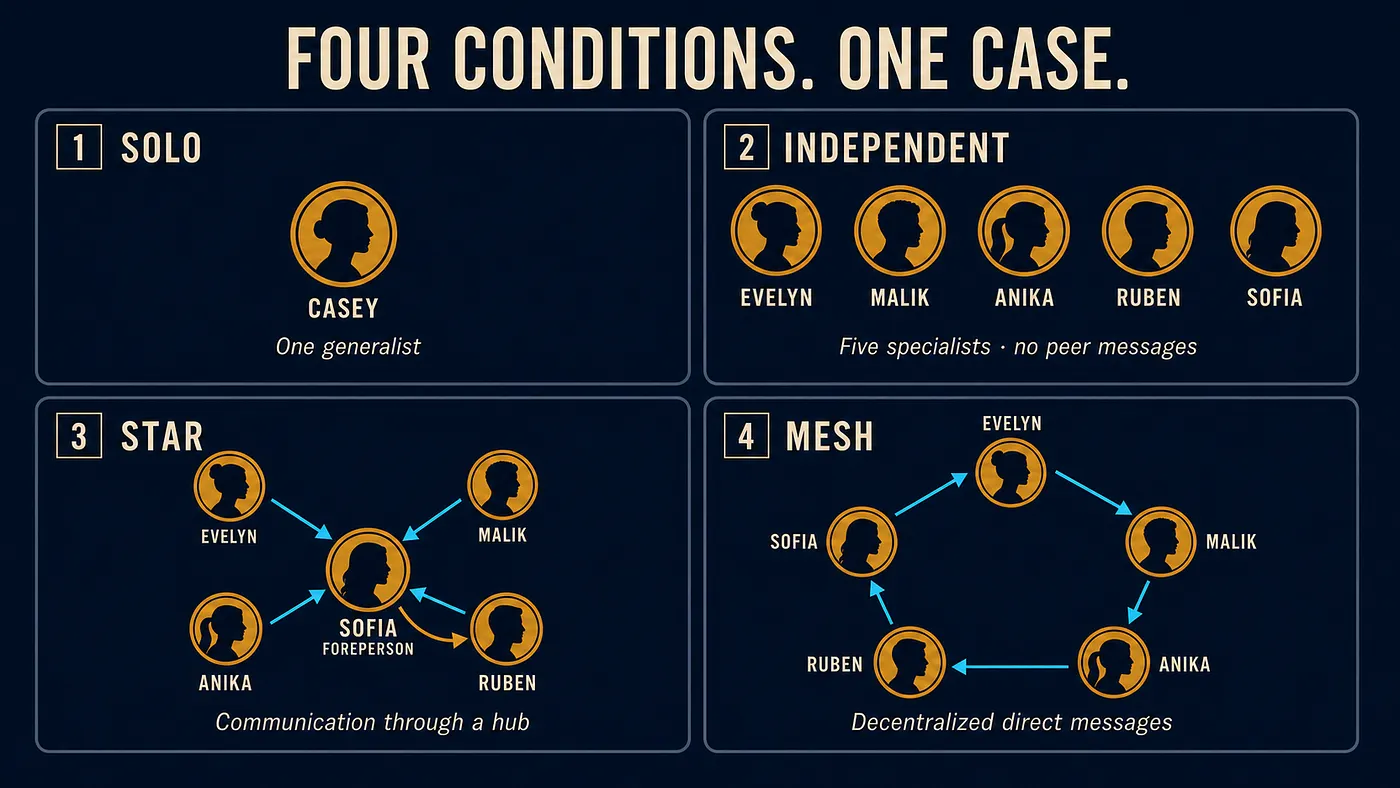
Independent versus Star or Mesh is the clean communication comparison. Solo is useful context, but it also changes panel size, persona composition, and inference budget.
Star is not an automatic broadcast. Sofia receives four independently authored messages, then chooses one juror and one issue to address. This makes her an information hub and a possible bottleneck.
Mesh is not a group chat. Each juror receives an explicit turn, selects an eligible recipient, chooses a human communication move, cites public evidence, and sends one addressed task. Only the selected receiver updates from that peer message.
The juror's public application response names that choice move:
{
  "move": "attempt_persuasion",
  "target_id": "juror_ruben",
  "message": "How does E3 change your view of who controlled the deployment?",
  "evidence_ids": ["E3"],
  "public_intent": "Test whether deployment control changes the responsibility assessment."
}
The name is deliberate. action already belongs to ProtoLink's outer runtime
protocol: final, tool_call, and agent_call describe what the runtime
should do, while an agent_call also uses its own action field for infer or
tool_call. Calling the courtroom-level choice a move keeps application
meaning separate from runtime intent and helps smaller JSON models avoid
combining the two schemas. Internally, the report may still group these values
as authored action types; the model-facing application contract uses move.
For a valid controlled comparison, the saved public-record hashes and control fingerprints must also match. The deterministic reference fixture guarantees that match. Live-model hearings may vary, so the generated metadata makes the assumption checkable rather than implicit.
Human Roles, Not Seeded Opinions
The five specialist jurors use recognizable professional perspectives:
| Juror | Perspective |
|---|---|
| Evelyn Brooks | Former collision detective who reconstructs physical sequences |
| Malik Thompson | Civil-rights lawyer attentive to burden of proof and institutional power |
| Dr. Anika Rao | Human-factors psychologist watching for automation and hindsight bias |
| Ruben Park | Site-reliability engineer focused on deployment controls and incident ownership |
| Sofia Bell | Investigative journalist and foreperson connecting documents, incentives, and timelines |
Their prompts do not say "begin 61/100 convinced" or expose mechanical
strategies such as reinforce_ally. They describe a role, professional habits,
personality, knowledge boundary, and decision rule in natural language. The
agent authors its initial public position.
The deterministic provider uses private fixture coefficients so the offline golden path is reproducible, but those coefficients never appear in the human-facing prompts. With a live provider, the model receives the character, case, admitted record, and output contract—not a prewritten opinion.
Explicit Agents and Direct Calls
The example keeps every participant visible in
run.py.
There is intentionally no large factory hiding the composition. An agent is a
normal ProtoLink Agent with a card, transport, model, and prompt:
software_engineer_agent = Agent(
    card=AgentCard(
        name="software_engineer",
        description="Perception engineer who filed the pre-release warning.",
        url=f"runtime://ai-liability/{namespace}/software-engineer",
    ),
    transport="runtime",
    llm=model_for_role(
        args.provider,
        role="software_engineer",
        seed=args.seed,
        model=args.model,
        base_url=args.base_url,
        temperature=args.temperature,
    ),
    system_prompt=ROLE_PROMPTS["software_engineer"],
)
Once two agents exist, the essential communication path is equally direct:
task = Task.create_infer(prompt=prompt)
result = await sender.call_agent(receiver.card.url, task)
The full example adds run/session/trace metadata, application validation, and bounded repair feedback around those calls. It does not replace the exchange with a hidden workflow graph pretending to be a conversation.
The world engine acts as a procedural referee. It schedules the hearing, enforces evidence identifiers and the selected topology, validates observable application responses, freezes ballots, and writes artifacts. Agents author the arguments, testimony, juror decisions, recipients, and peer messages.
ProtoLink carries addressed tasks, public application responses, and transport telemetry. The application stores observable public state; it neither requests nor stores private chain-of-thought.
What the Deterministic Replay Shows
The default reference provider is offline, deterministic, and intentionally
designed to make the communication treatment visible in one quick run:
| Condition | Verdict | Ballots (guilty–not guilty) | Mean final guilt | A2A events | Deliberation flips |
|---|---|---|---|---|---|
solo | Guilty | 1–0 | 78.59 | 27 | 0 |
independent | Not guilty | 2–3 | 77.56 | 83 | 0 |
star | Not guilty | 2–3 | 80.21 | 93 | 0 |
mesh | Guilty | 3–2 | 80.54 | 93 | 1 |
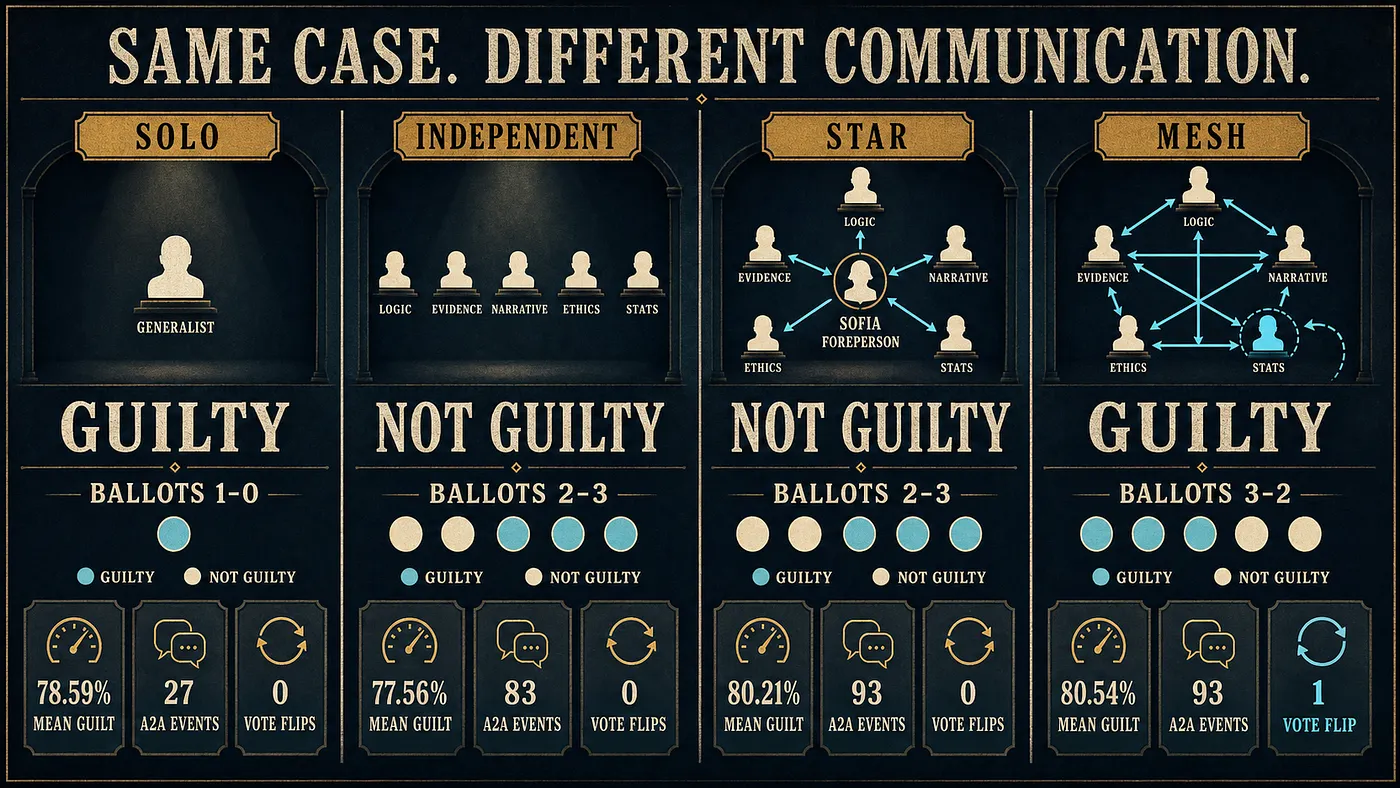
These are deterministic fixture results, not evidence that one topology is generally superior.
The independent and mesh juries receive the same public record. In the mesh
run, Sofia challenges Anika with the interaction between the unvalidated C-91
calibration in E3 and the interaction tests in E7. Anika's public guilt
register moves from 77.90 to 81.41, and her separately authored categorical
vote changes from not guilty to guilty.
That exchange precedes the only deliberation vote flip in the fixture. The report deliberately says "observed after message," not "caused by message." Establishing causality would require matched message-removal or replacement ablations.
The star condition also raises the mean guilt register but does not change the 2–3 verdict. More communication, more confidence, and more consensus are not the same thing. The point of the experiment is that who can address whom changes which assumptions can be challenged.
The fixture contains a private synthetic answer so the tooling can distinguish agreement from correctness against a known fictional outcome. No tribunal agent receives that hidden fact. The golden path is useful for testing the A2A protocol and replay UI; one designed case and one seed cannot establish that mesh communication makes agents smarter.
The HTML Replay Is Generated Automatically
Running the simulation produces more than a terminal verdict. When run.py
finishes, it automatically generates a standalone interactive report.html
for each condition and prints the exact path to open. No web server or frontend
setup is required.
The embedded report below is the generated artifact from a local Mesh run using
Ollama and gemma4:e4b. The replay UI and recorded A2A events are contained in
the report itself; this is a saved example run, not a live simulation:
python examples/ai_courtroom/run.py \
  --provider ollama \
  --base-url "http://localhost:11434" \
  --model gemma4:e4b \
  --juror-provider ollama \
  --juror-base-url "http://localhost:11434" \
  --condition mesh \
  --seed 7
If the embedded replay is too narrow for detailed inspection, open the generated Mesh report in a new tab.
The report lets a developer:
- play or step through every A2A exchange;
- see the active sender, receiver, communication move, and public intent;
- read the authored message and receiver's public reply;
- inspect evidence citations and ProtoLink task metadata;
- watch synchronized before/after guilt registers and votes;
- compare juror trajectories and the pre/post-deliberation verdict;
- explore the influence graph and full accessible event ledger.
An all-condition run also creates an index.html comparison page for the
Solo → Independent → Star → Mesh ladder. The models can stop running while the
saved interaction remains replayable and shareable.
Run the Example
From the repository root:
python examples/ai_courtroom/run.py
The default command runs all four conditions through the deterministic
reference provider. It requires no network connection, provider account, or
API key.
Run one condition:
python examples/ai_courtroom/run.py \
  --provider reference \
  --condition mesh \
  --seed 17 \
  --verbose
The terminal prints the generated report path when the run finishes.
Run with Ollama
Install the ProtoLink LLM extras, start Ollama, and name the exact local model tag:
python -m pip install -e '.[llms]'

python examples/ai_courtroom/run.py \
  --provider ollama \
  --model "<exact-ollama-model-tag>" \
  --base-url "http://localhost:11434" \
  --condition star \
  --verbose
Use the juror-specific flags when the jury should use a different model or endpoint from the tribunal actors:
python examples/ai_courtroom/run.py \
  --provider ollama \
  --model "<tribunal-model-tag>" \
  --base-url "http://localhost:11434" \
  --juror-provider ollama \
  --juror-model "<jury-model-tag>" \
  --juror-base-url "http://localhost:11434" \
  --condition mesh \
  --verbose
Running every condition against a live provider requires an explicit acknowledgement because it creates many model calls:
python examples/ai_courtroom/run.py \
  --provider ollama \
  --model "<exact-ollama-model-tag>" \
  --base-url "http://localhost:11434" \
  --condition all \
  --allow-multi-condition-live \
  --verbose
Generated Artifacts
Each condition writes:
| File | Purpose |
|---|---|
result.json | Full public record, configuration, decision histories, messages, metrics, and verdict |
summary.json | Compact outcome and comparison data |
transcript.md | Escaped public hearing and deliberation transcript |
report.html | Standalone interactive replay and analysis |
traces.jsonl | ProtoLink task, inference, and A2A telemetry |
An all-condition run also writes the comparison index.html.
Saved metadata includes the resolved provider and model for every agent, evidence order, round count, retry limits, public-record hash, comparison control fingerprint, latency, estimated tokens, grounding, routing, and repair information.
Why This Is an Important ProtoLink Example
The AI Courtroom demonstrates several A2A properties that disappear inside a monolithic orchestrator:
| ProtoLink property | What the experiment makes visible |
|---|---|
| Operational identity | Every participant has an address, role, model, prompt, and task history |
| Direct communication | Messages travel from one named agent to another through a ProtoLink task |
| Configurable topology | The same agents can be isolated, hub-connected, or directly connected |
| Agent-authored routing | Mesh jurors choose recipients and communication moves themselves |
| Interaction as data | Messages, citations, responses, state changes, and traces become replayable artifacts |
| Independent models | Tribunal actors and jurors can use different providers behind one protocol |
| Visible failure | Invalid targets, malformed outputs, repairs, and routing fallbacks are measured |
| Preserved disagreement | The runtime does not force every view into one synthetic consensus |
The result is not merely an AI courtroom. It is a small laboratory for studying communicating AI societies with inspectable protocol boundaries.
Experiments to Build Next
The included fixture makes several stronger studies possible:
- Provider comparison: keep the tribunal record fixed and change only the juror provider.
- Defence persuasion: add a dedicated defence-counsel agent, keep the jury fixed, and compare how often different models move jurors toward not guilty.
- Message ablation: remove or replace one peer message to test whether an observed after-message change survives.
- Topology replication: repeat Independent, Star, and Mesh across seeds, model versions, evidence orders, and multiple cases.
- Influence concentration: measure whether a model depends too heavily on a foreperson or repeatedly targets aligned jurors.
- Protocol reliability: compare grounding, invalid citations, repair rate, routing fallbacks, latency, tokens, and cost—not only verdicts.
A persuasive model is not necessarily a truthful or correct model. In the default fixture, stronger defence advocacy can move the jury away from the hidden synthetic answer. Persuasion, grounding, calibration, protocol reliability, and correctness therefore belong on separate axes.
Create a Different Scenario
The C-91 Incident is one configuration of the communication scaffold. The least-work extension keeps the binary tribunal and current cast shape:
- Replace
CASE, admitted evidence, and the synthetic evaluator fixture incourtroom/case_data.py. - Rewrite
ACTOR_PROFILES,ROLE_PROMPTS, andJUROR_PROFILES. - Update the explicit
AgentCardnames, descriptions, and tags inrun.py. - Keep evidence IDs in the
E1,E2, … convention, or update the associated prompt and validation contracts. - Update
courtroom/reference_llm.pyand the tests when the new case also needs a deterministic golden path.
The reusable structure remains: addressable agents, a controlled public record, explicit communication topology, observable state, frozen decisions, an event ledger, comparisons, traces, and replayable HTML.
The same pattern can support an incident review, scientific peer-review panel, product-risk council, policy committee, negotiation, or other multi-agent decision environment. A non-courtroom domain also needs new decision schemas, procedure, metrics, and report language; this is a reference architecture, not a generic one-file scenario loader.
Limitations
- The case, prompts, fixture coefficients, and synthetic truth are authored.
- Solo changes more than communication and is not a topology-only control.
- One case and one seed cannot establish that a topology or provider is better.
- A public reason may be incomplete, simplified, or post-hoc.
- An after-message change is temporal association, not causal attribution.
- Agreement may represent correction, conformity, anchoring, or shared error.
- Model personas are prompt-induced behaviours, not human identities.
- The simplified fictional charge must not be applied to real people, products, or legal cases.
The next serious experiment should preregister cases, providers, topologies, replicates, and message ablations, then publish failures and reversals as well as successful outcomes.
See Also
- Examples - All runnable examples and learning paths
- Agents - Agent identity, lifecycle, tools, and delegation
- A2A - ProtoLink's A2A model and compatibility boundary
- LLMs - Providers, inference, parsing, and bounded correction
- Telemetry - Task and inference observability
- Runtime - Run context, events, reports, replay, and policies